I spend a fair amount of time looking at labels before I pour anything. Independent bottlers in particular tend to put a lot of information on the bottle, and a little of it is required by law, some of it is voluntary, and some of it is simply the bottler’s own wording. The trouble is that all three look identical in small print.
So while the glass is temporarily empty, I thought I would go through some of the bottles I have reviewed and work out what each line on the label actually tells you – and what it does not.
For the legal side, I am relying mainly on the Scotch Whisky Regulations 2009, together with the Scotch Whisky Product Specification, where it adds relevant details. I will distinguish those rules from labelling conventions and voluntary information supplied by bottlers.
And, as we will eventually discover, this matters: something not specifically defined by the Scotch Whisky Regulations does not necessarily mean that anything goes.
Start with the category.
The one thing every Scotch bottle must state on its front label is its category. There are five: Single Malt Scotch Whisky, Single Grain Scotch Whisky, Blended Malt Scotch Whisky, Blended Grain Scotch Whisky and Blended Scotch Whisky.
Wording matters more than people think, because single refers to one distillery and nothing else. It says nothing about the number of casks, the number of vintages or the number of years.
A single malt can, therefore, be – and usually is – a vatting of many casks. Conversely, something from a single cask is not necessarily a single malt.

The regulations also let a Scottish region or locality sit directly in front of the category, as long as the whisky was distilled there. That is how you get ‘Speyside Single Malt Scotch Whisky’ on an Aberlour 16, which is the plainest version of the format you will find.
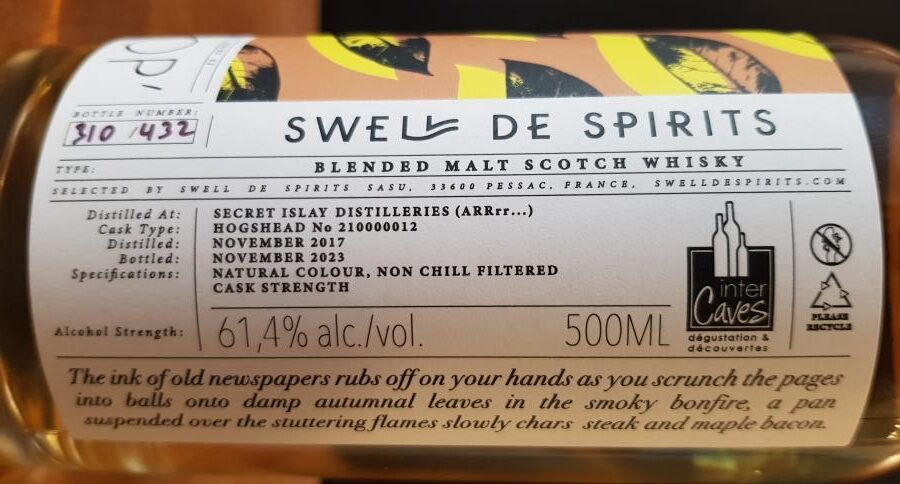
Something more interesting is the Secret Islay I reviewed from Swell de Spirits. The front says ‘Blended Malt Scotch Whisky’, although the bottle comes from a single hogshead, number 210,000,012, bottle 310 of 432.
A single cask and a single malt are different questions.
Here the Islay whisky was, according to the bottler, teaspooned, meaning a small amount of another malt was added, and that is what moves it out of a single malt and into a blended malt. A whisky can, therefore, be both single cask and blended malt at the same time.
Who distilled it, and how loudly the label says so.
Some distillery names are protected. Schedule 1 of the Regulations lists them, and the rule is that a listed name cannot be used as a brand name, or as part of one, or in a similarly prominent way, unless the whisky was wholly distilled there.
There is also a wider rule: the presentation as a whole must not lead people to believe that the whisky came from a distillery other than the one that actually made it.

What the rule does not do is stop a bottler from naming the true distillery.
The Whiskybase Ben Nevis 2010, 15 years old at 54.2%, is a good illustration. The large lettering is WHISKYBASE, which is the brand. Ben Nevis sits lower down, in smaller type, like ‘Distilled at Ben Nevis Distillery’. The distillery is a fact about the liquid, not the brand.
The Archives Tomatin 1994 is worth a look for a different reason. The front reads ‘Distilled at’, then ARCHIVES in large type, then ‘Tomatin Distillery’ underneath.
Read quickly, that layout is a little odd. The back label clears it up: the whisky was selected and imported by Whiskybase and bottled in Scotland, and Archives is a series name.
I am not suggesting anything improper about the layout. It is simply a good reminder that the regulations look at the presentation of the product as a whole – and that the back label often answers what the front leaves open.

Then there is the opposite approach, where the distillery is kept secret.

The Whiskybase Secret Highland, vintage 2008, 16 years old at 59.3%, bottle 033 of 247, says ‘Distilled at a Secret Highland Distillery’.
It withholds the name, but Highland is still a protected region, so that part of the claim has legal weight: the whisky was distilled within the Highland region, as the regulations define it.
What the label does not support is any guess at which distillery it is.
I have a separate piece planned on how to handle undisclosed whisky, so I will leave that there.
Age, vintage and the dates that go with them.
This is where labels get among their most regulated, and the rules are more specific than many people realise.
An age or maturation period has to be given in years and refers to the youngest whisky in the bottle.
A reference to when a whisky was distilled can appear only if it relates to a single calendar year and all the whisky in the bottle was distilled in that year. It must then be accompanied, in the same field of vision, by the bottling year, maturation period or age. And a number cannot be used if it could be mistaken for the age, maturation period or distillation year. The Archives Tomatin shows the pattern well. The front says ‘Vintage 1994 / 31 Years Old’. The back gives the exact dates: distilled 13 October 1994, bottled 25 November 2025. Counted out, that is 31 years and 43 days, and the label correctly gives the age in whole years. It also gives the full distillation date rather than merely the vintage year; the reference still relates to a single calendar year.

The Hidden Spirits Strathisla is a second format. It reads ‘Distilled 2002–2018 bottled’ and ‘Aged 15 years’, with cask reference ST218 at 51.2%.
There are three numbers close together there, and each one means something different. That is exactly the sort of situation the rule on potentially confusing numbers is intended to address.
In this case it is clear enough: distilled in 2002, bottled in 2018 and aged 15 years, with ST218 being the cask reference.
A vatting of different vintages is the more interesting case.
The Glen Grant 30 ‘Whiskyland Chapter Twenty-Two’ from Decadent Drinks, which is a marriage of a 1993 refill barrel and a 1995 first-fill sherry hogshead, cannot carry a single distillation-year claim because not all of the whisky was distilled in the same calendar year.
The ‘30 years’ therefore refers to the youngest whisky in the vatting, which here is the 1995 cask.
That is an important distinction. An age statement does not tell you the age of everything in the bottle. It tells you the minimum.

Casks, outturns and everything the law leaves alone.
The 2009 regulations themselves say surprisingly little about the sort of cask information commonly printed on independent-bottler labels.
At the basic level, Scotch must mature in Scotland for at least three years in oak casks with a capacity no greater than 700 litres. The Product Specification adds further requirements concerning the types of casks that may be used and what they may previously have contained.
But the 2009 Regulations do not define the terms independent bottlers routinely put in large letters on labels: single casks, small batch, exclusive, private cask, refill, and so on.
Nor do they define outturns or bottle numbers.
So when you read those words, you are generally reading information supplied by the bottler rather than one of the five statutory Scotch categories.
That does not mean the terms can be used misleadingly. It means that you cannot simply open Regulation 3 and find a legal definition of ‘small batch’.

The Kintra Balblair is, for me, one of the most complete examples I have.
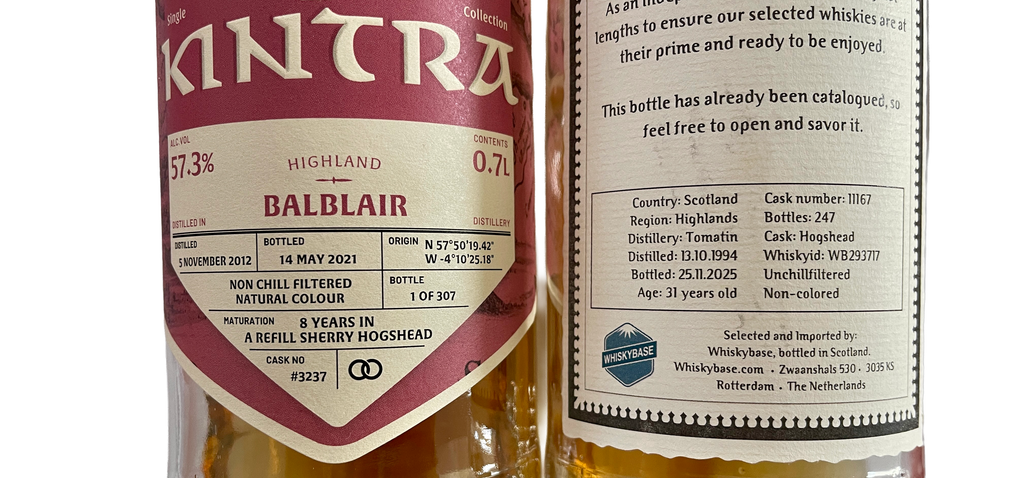
It was distilled on 5 November 2012 and bottled on 14 May 2021, which gives the stated eight years. It is a Highland single malt, cask number 3237, a refill sherry hogshead, bottle 1 of 307, at 57.3%, non-chill filtered and natural colour.
Each of those fields answers a different question.
The dates say when the whisky went in and came out. The cask number identifies the cask. ‘1 of 307’ tells us both that this is bottle number 1 and that the stated outturn is 307 bottles.
‘Refill sherry hogshead’ gives us information about the general cask format and its previous use: this was not presented as a first-fill cask.
What it still does not tell you is the oak species, the type of sherry, how many previous fills the cask had seen, how it had been seasoned or its exact capacity. A hogshead is commonly around 250 litres, but the word does not give you an exact measurement.
‘Refill’ is informative, but it is not a complete maturation history.
Even the most detailed label stops somewhere.
The Archives Tomatin gives a comparable amount of information on its back label: cask 11,167, hogshead, and 247 bottles. Placing the two side by side is a good way to see how much a bottler chooses to share.
Strength, colour and filtration.
The minimum bottling strength for Scotch is 40% ABV, and the only permitted additions are water and plain caramel colouring – E150a.
Beyond that, things become more interesting.
‘Natural colour’ and ‘non-chill filtered’ are not defined by the Scotch Whisky Regulations 2009. Nor do those regulations oblige a bottler to tell you whether caramel colouring was used or whether the whisky was chill-filtered. Separate labelling requirements can apply in individual markets, but that is another subject entirely.
‘Cask strength’ is slightly different. The term is not defined in the 2009 Regulations either, but the Scotch Whisky Product Specification does constrain its use: the alcoholic strength of a cask-strength Scotch Whisky must not be adjusted after maturation.
So it should not be thrown into quite the same bucket as an undefined marketing expression.
The Swell de Spirits Secret Islay is the full version. Its side label gives 61.4%, natural colour, non-chill filtered and cask strength, along with distilled in November 2017 and bottled in November 2023.
Those statements tell us considerably more than the legal minimum.
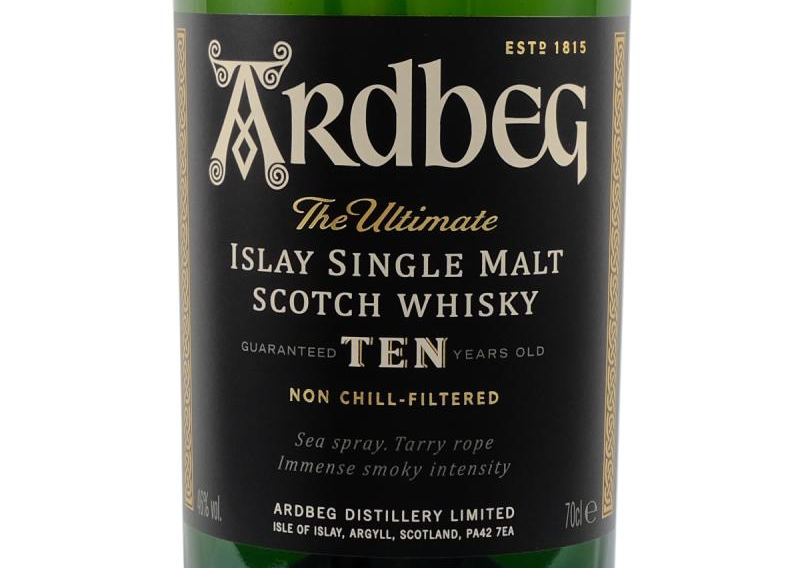
The Ardbeg Ten is a useful partial version.
It says ‘Non Chill-Filtered’ at 46%. What it does not do on the label shown here is make a declaration about natural colour.
That distinction matters.
If a label says ‘natural colour’, I have a positive statement to work with. If it says nothing, I do not have the opposite statement. Silence does not magically become evidence.
So I would not turn ‘colour not declared’ into ‘probably natural colour’, or ‘probably coloured’, without another source supporting it.
The same principle applies throughout this article.
Rather than trying to rank every possible source rigidly, I would treat an explicit statement on the bottle, an official technical sheet or product page, and direct confirmation from the bottler or producer as forms of positive evidence whose usefulness depends on the question being asked.
Silence is different.
Silence proves nothing in either direction.
Old labels, and what has changed.
The last piece is the most historical.
The regulations prohibit the phrase ‘pure malt’ and its derivatives, and they also prohibit using ‘pure’ to describe ‘malt’ even when the two words are separated.
There is no current Scotch category called Pure Malt.
Labelling done on or before 22 November 2011 is protected by a transitional rule; however, which is why you can still encounter the wording on older bottles.

The Chivas Brothers Strathisla 12 says ‘Pure Highland Malt Scotch Whisky’, aged 12 years, 43%.
The ‘Highland’ on a Speyside distillery is also worth a note – but not for quite the reason you might initially think.
Speyside falls within the legally defined Highland region. The Scotch Whisky Association’s guidance on the Regulations explicitly confirms that Scotch distilled in Speyside may be described as either Speyside or Highland.
So ‘Highland’ on a Strathisla bottle is not inherently contradictory.
Set that bottle against the Hidden Spirits Strathisla 2002 and the difference is clear.
The older official label gives brand, age and strength, together with terminology belonging to its period. The newer independent one gives the category with its region, a named distillery, the age, both years, a cask reference, and a line saying it was produced, distilled and matured in Scotland and bottled for a company in Italy.

More information is not automatically better, but it shows how label conventions have moved.
A short routine.
When I pick up an independent bottle now, I run through the same handful of questions.
What category does it state, and is a region or locality placed in front of it?
Is a distillery named, and how prominently?
What do the dates say, and do the numbers mean what they look like they mean?
What has the bottler told me about the cask – and, just as importantly, what has it left out?
Are strength, colour and filtration each stated separately?
And have I read the back label?
Anything that is not specifically defined by the Scotch Whisky Regulations or Product Specification, I treat as information that needs to be understood in context rather than quietly turning convention into law.
It is a useful habit when reading labels, and one I will keep coming back to in reviews.
Too long; didn’t read
(Then why do I bother?! ;))
This is the short version of what a Scotch label can show, and what the rules actually tell us about each item.
Items regulated by the Scotch Whisky Regulations 2009.
| Label item | Rule | What it means |
|---|---|---|
| Category — Single Malt, Single Grain, Blended Malt, Blended Grain, Blended Scotch | Reg. 3(2), 8 | The category must appear on the front, with the required wording and presentation. |
| Region or locality before the category | Reg. 8(5), 10 | It may be used only where the whisky was distilled there. Protected names include Campbeltown, Islay, Highland, Lowland and Speyside. |
| Distillery name | Reg. 9, Sch. 1 | Protected distillery names are subject to restrictions on brand-like use and presentation must not misleadingly suggest another distillery. |
| Age statement | Reg. 12(1) | Given in years and refers to the youngest whisky in the bottle. |
| Distillation year | Reg. 12(2) | Permitted only where all the whisky was distilled in the same calendar year, with accompanying age/maturation/bottling information as required. |
| Potentially confusing numbers | Reg. 12(3) | Numbers that could be mistaken for an age, maturation period or distillation year are restricted. |
| “Pure malt” | Reg. 11 | Prohibited, subject to the transitional provisions for older labelling. |
| Minimum strength | Reg. 3 | 40% ABV. |
| Additions | Reg. 3 | Water and plain caramel colouring are the permitted additions. |
| Basic maturation requirements | Reg. 3 | At least three years in Scotland, in oak casks no larger than 700 litres. |
| Exporting Single Malt Scotch Whisky | Reg. 7 | Single Malt Scotch Whisky is subject to specific restrictions on leaving Scotland other than in labelled bottles for retail sale. |
The five-category system, geographical descriptions and related labelling restrictions are set out in the 2009 Regulations; current SWA guidance also confirms, among other things, that Speyside lies within Highland for these purposes.
One important addition from the Product Specification.
| Label item | What it means |
|---|---|
| Cask strength | The alcoholic strength of Scotch described as cask strength must not be adjusted after maturation. |
That is why ‘cask strength’ should not simply be grouped with completely undefined voluntary terminology.
Details the 2009 Regulations do not specifically define.
The Regulations themselves do not provide whisky-specific definitions for:
- Single cask, small batch, exclusive or private cask.
- Outturn and bottle number.
- First fill and refill terminology.
- Natural colour.
- Non-chill filtered.
Nor does silence about colour or filtration establish what happened.
These descriptions can still be meaningful – sometimes extremely meaningful – but you have to distinguish what the bottler tells you from what Scotch law defines for you.
How to weigh the evidence.
An explicit statement on the bottle is evidence.
An official technical sheet or product page can provide further evidence.
Direct confirmation from the bottler or producer can answer questions the label does not.
Which source matters most depends on what you are trying to establish.
But silence remains silence.
To conclude.
A whisky label can tell you a great deal, but it does not tell you everything.
The useful distinction is between information that Scotch whisky law defines or protects – category, age, geographical descriptions, distillation year and so on – and the additional details a bottler chooses to provide, such as cask type, refill status, filtration or colour.
And even apparently straightforward descriptions have limits.
‘Refill sherry hogshead’ sounds very precise until you ask what kind of oak it was, what kind of sherry it held, how it was seasoned, how many times it had previously matured whisky and exactly how large it was.
‘Natural colour’ answers one question but says nothing about filtration.
‘Single cask’ tells you something about the number of casks but does not tell you whether the whisky is legally a single malt.
And a distillery name – or its conspicuous absence – can tell a story of its own.
The best labels make that work easy. They give enough context to understand what is in the bottle without encouraging the information to support conclusions that it cannot.
And where a label is silent, it is usually better to leave the question open than to turn an assumption into a fact.
Oh, and, want some good news?
Depending on the country – and the spirit – the rules change.
So everything I just told you only applies to Scotch whisky!
Legal and technical references: The Scotch Whisky Regulations 2009 (SI 2009/2890), particularly regulations 3 and 7–13 and Schedule 1; and the Scotch Whisky Product Specification. The current official UK GI register identifies the Product Specification as the governing specification for Scotch Whisky.
The Scotch Whisky Regulations 2009 – legislation.gov.uk
Official Scotch Whisky GI and Product Specification – GOV.UK
SWA guidance on the Scotch Whisky Regulations