After the two large French whisky reviews from Friday and Monday, we turn back to Scotland with a shorter review as well. We take a look at Tullibardine with quite opposite bottlings: an ex-bourbon non-age-statement official bottling with the Tullibardine Sovereign, and a 22-year-old Ruby port matured Tullibardine from the independent bottler The Whisky Agency. But first, as it is usual when we introduce a distillery on More Drams, let’s have a short look at the distillery itself.
Tullibardine Distillery
Tullibardine is a Highland distillery in Blackford, Perthshire, located beside the Ochil Hills and the A9 corridor between Stirling and Perth. The modern distillery was founded in 1949 by architect and distillery designer William Delmé-Evans on the site of an older brewery; the location itself has a brewing history claimed to reach back to 1488.
Tullibardine is notable as one of the first purpose-built Scotch whisky distilleries of the post-war period. Delmé-Evans established it in 1949, but it changed hands several times: Brodie Hepburn acquired it in 1953, Invergordon Distillers took over in 1971, and Whyte & Mackay acquired Invergordon in 1993. Whyte & Mackay mothballed Tullibardine in 1994, leaving it silent until a consortium led by Alan Williamson bought and restarted it in 2003.
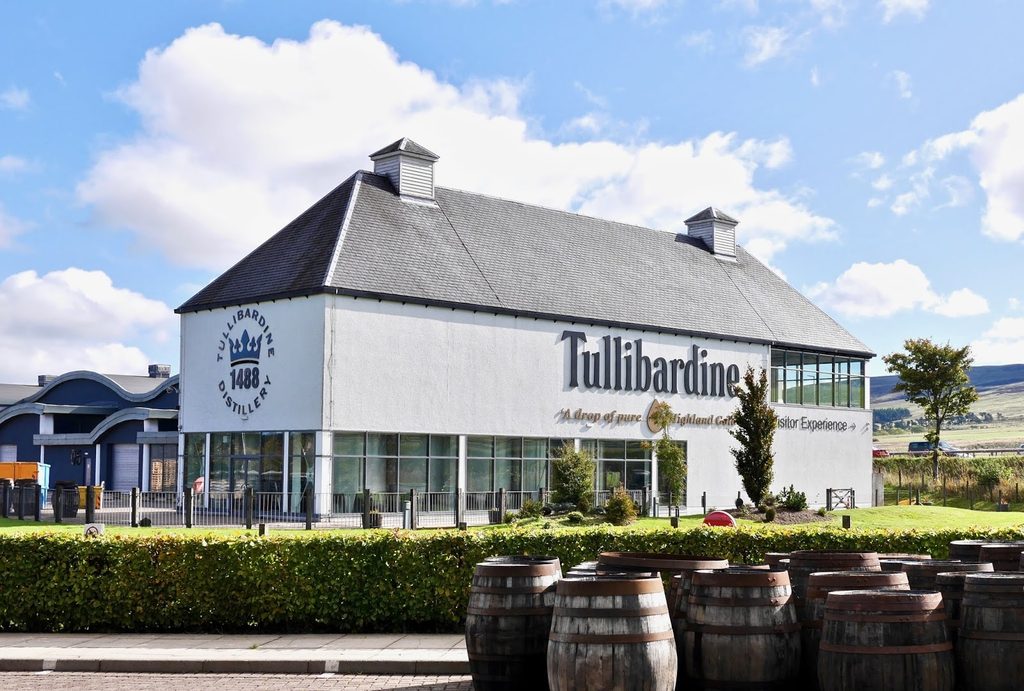
The current owner is Terroirs Distillers, the Scotch-whisky subsidiary of the French family group Picard Vins & Spiritueux. Picard bought Tullibardine in 2011, bringing its Highland Queen and Muirhead’s brands together with a distillery source; Terroirs Distillers now manages those Scotch brands as well as Tullibardine.
The distillery has a 6-tonne semi-lauter stainless-steel mash tun and, following recent upgrades, ten stainless-steel washbacks. The washbacks are sealed in order to capture CO². Distillation is made through two wash stills and two spirit stills; the wash stills are approximately 15,000 litres and the spirit stills around 11,000 litres. Fermentation lasts from 55 to 60 hours. Its nominal annual capacity is about 3 million litres of pure alcohol (The Malt Whisky Yearbook is always a great reference for this kind of information).
Tullibardine Sovereign (2020) Review
Sovereign is Tullibardine’s signature bourbon-cask expression, released in 2013 as part of the distillery’s refreshed core range. It is an official Highland single malt, bottled at 43% ABV in a 70 cl format, with no stated age, nor indication regarding chill filtration or added colouring. The whisky is matured exclusively in first-fill ex-bourbon barrels. Expect to pay from €26 up to €45 in Europe, and around £36–38 in the UK.
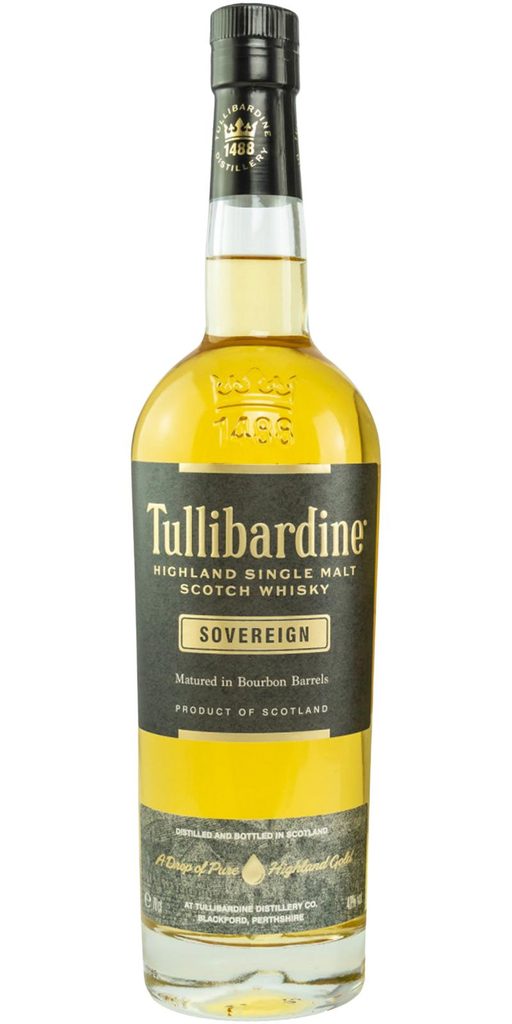
Colour:
Pale straw.
Nose:
Neat: Light, clean and creamy, led by vanilla, cocoa butter and white chocolate. Pear drops, green apple, ripe pear and peach sit over sweet barley, malt biscuits, honey and butter.
Palate:
Neat: The palate is soft and creamy at first, with vanilla custard, crème brûlée, buttered toast and malt biscuits. Apple, pear juice, pear cider and lemon form the central fruit profile, supported by milk chocolate, maple syrup and a gentle caramelised sweetness.
Finish:
The finish is medium, beginning creamy and vanilla-led before drying into toasted oak, cinnamon, white pepper and soft cocoa. Pear, sweet malt and occasional lemon or mineral notes linger briefly.
Comments:
The Tullibardine Sovereign feels very young, which is to be expected from an entry-level non-age-statement core expression: the spirit is naked and lacks time in casks. That’s not too much a problem if you get a bottle for less than £30, but I wouldn’t pay more than that, as there are much better options otherwise.
Rating: 5.5/10
Tullibardine 2004 The Whisky Agency (2026) Review
Next, we have a 2004 Tullibardine, matured in a ruby port cask for 22 years, before The Whisky Agency bottled it in 2026. This was bottled at 47.8% ABV (I’m not sure if this was its natural cask strength), without chill filtration nor added colour. It seems it will be available in a few days (at the time of writing). Check dein-whisky.de, for instance, where it is priced around €210 a bottle.
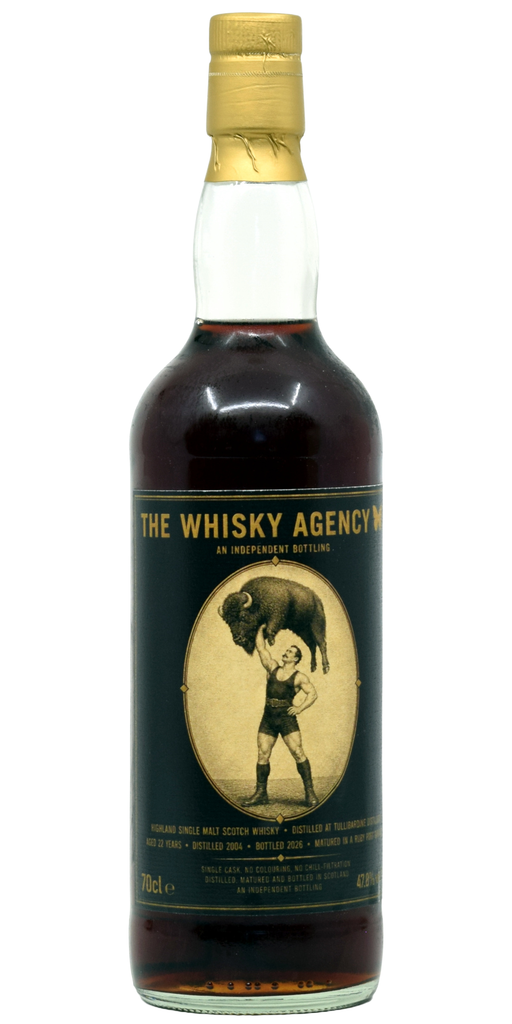
Colour:
Brown-red like a dark old oak.
Nose:
Neat: The nose feels immediately thick and rich, with blackberries, mixed dark berries, stewed plums, tarte tatin, dates and notes of charred wood. Caramelised brown sugar brings some sweetness, and dark chocolate balances it with a light bitterness. The nose shows a good intensity without being harsh nor too vinous.
Palate:
Neat: The palate is more vinous than the nose led to expect, however. Blackberries, figs and juicy raspberries with chocolate brownie, tobacco and roasted nuts; the palate is also more vibrant and prickly than the nose. The mouthfeel is thick and chewy. There is more red/dark fruity sweetness than on the nose, and a bit less balance, as the ruby port really shows a strong impact and presence.
Finish:
The finish shows a good length, returning to dark fruits, ungrounded peppercorns and a light herbal dryness, as well as raspberry jam and a few dark cherries.
Comments:
Well, don’t judge a book by its cover, they say… and they’re right. Tullibardine is not the distillery name that makes me dream, and ruby port maturation even less. And despite that, I really like this Ruby Port matured Tullibardine, especially its nose, as it shows a great balance between fruits, wood, sweetness and bitterness, without becoming vinous. The palate is closer to what I expected however, the ruby influence is stronger, and the palate is a tad vinous, but this stays manageable even if you’re not into port maturation, which I used to be, but I am not anymore.
Rating: 7/10
Sample of the Tullibardine 2004 provided by The Whisky Agency. As usual, this does not change what I will write.