
Ethanol, aroma molecules, cloudy whisky and the chemistry behind adding a few drops of water.
“Add a few drops of water. It opens up the whisky.”
We’ve all heard that advice. Sometimes it works beautifully: a powerful whisky suddenly reveals fruit, flowers or delicate smoke that seemed hidden behind the alcohol. Other times, the whisky becomes flatter, less expressive or simply watery. And occasionally, adding water makes the whisky cloudy.
But why? Surely adding water only reduces the alcohol concentration and dilutes everything else?
Not quite. Whisky isn’t just alcohol, water and flavour compounds floating independently in a glass. It’s a complex chemical mixture, and changing the proportion of water can alter how its aromatic molecules behave, how they reach our noses and how we perceive them.
I’ve already encountered a particularly interesting example: three whiskies from Domaine des Hautes Glaces, drawn from the same cask but bottled at 46%, 52% and 59% ABV. Surprisingly, the middle strength was my least favourite.
So does water really open up whisky? And if it does, how much should we add?
Whisky is already mostly water
Before discussing dilution, there’s something worth remembering: even a cask-strength whisky contains a considerable amount of water.
A whisky bottled at 60% ABV contains approximately 40% water by volume, according to the conventional definition of alcoholic strength. A whisky at 46% ABV contains approximately 54% water. And one at 40% ABV? Well, you can do the maths.
Strictly speaking, these are approximate descriptions, since whisky also contains other compounds and ethanol-water volumes aren’t perfectly additive.
Whisky is a mixture dominated by water and ethanol, together with hundreds of other substances originating from fermentation, distillation and maturation. And water and ethanol are different solvents.
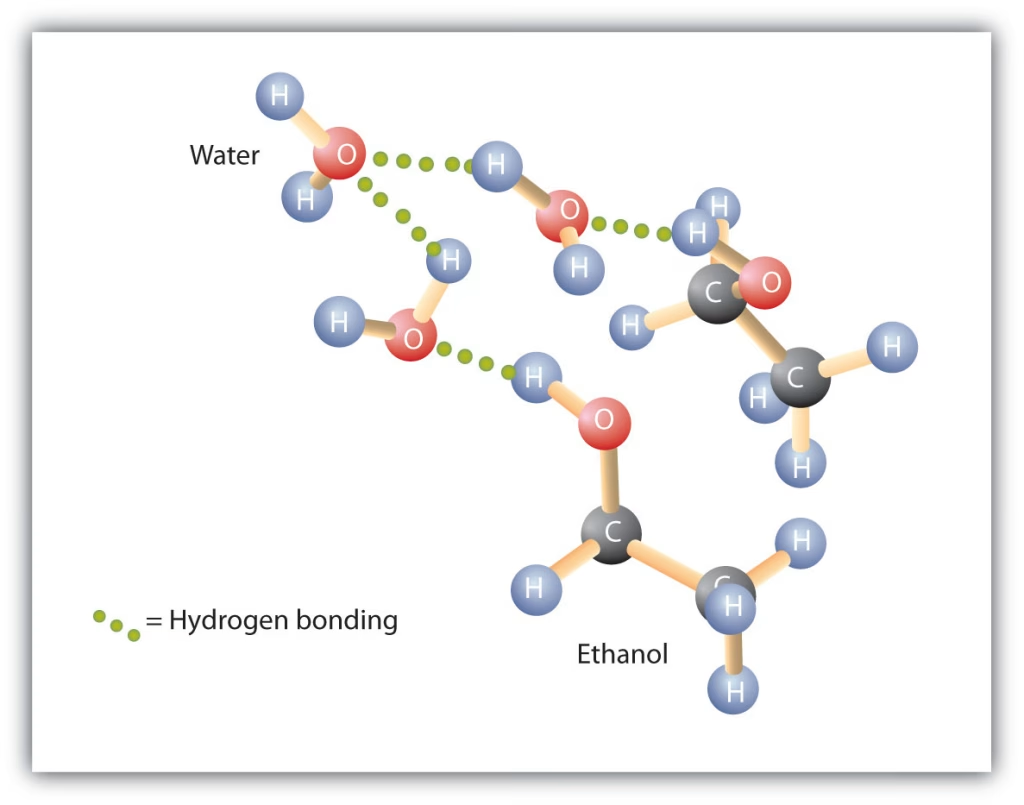
Water is strongly polar (quick reminder: a molecule is polar when its electrical charge is distributed unevenly). Ethanol is also polar, but its molecular structure includes a non-polar portion that allows it to interact with substances that dissolve poorly in pure water. That makes ethanol particularly useful for keeping certain aromatic compounds dissolved.
When we change the ratio of water to ethanol, we change the environment in which those compounds exist.
And that’s where things become interesting.
What happens when ethanol meets water?
Water molecules form networks of hydrogen bonds. Ethanol molecules can participate in these networks through their hydroxyl groups, while their non-polar portions interact differently with the surrounding liquid. As the alcohol concentration changes, so does the arrangement and behaviour of the mixture.
This matters because whisky’s aroma compounds don’t all interact with water and ethanol in the same way. Some are relatively comfortable in water-rich environments. Others interact more favourably with ethanol, while some have both water-loving and water-repelling characteristics.
These differences affect how readily compounds remain dissolved, interact with other molecules and escape into the air. Adding water therefore changes more than the concentration of flavour compounds: it changes the liquid in which they’re dissolved.
But does that necessarily make them easier to smell?
Guaiacol: the molecule that made whisky dilution famous
In 2017, researchers Björn Karlsson and Ran Friedman published a study entitled Dilution of whisky – the molecular perspective. The paper attracted considerable attention because it offered a molecular explanation for why adding water might enhance certain whisky aromas.
The researchers focused on guaiacol, a phenolic compound associated with smoky aromas. Guaiacol is particularly relevant to peated whisky, although it is only one of many compounds contributing to peat smoke.
Using molecular dynamics simulations, the researchers investigated how guaiacol behaved in mixtures containing different proportions of water and ethanol. They found that guaiacol tended to associate with ethanol molecules.
At lower ethanol concentrations, particularly around 45% ABV and below in their simulations, guaiacol was more likely to be found near the liquid-air interface. At higher concentrations, around 59% ABV and above, it was increasingly surrounded by ethanol molecules within the bulk liquid.
Why is this interesting? Because the distribution of aroma molecules between the bulk liquid, its surface and the surrounding air can influence aroma release. The study therefore proposed a possible explanation for why diluting a strong whisky could enhance the perception of smoky aromas.
But there’s an important qualification.
This was a computer simulation involving guaiacol, not a sensory experiment demonstrating that every whisky becomes more aromatic when diluted.
The researchers didn’t establish an ideal drinking strength for whisky, nor did they show that all aroma compounds behave like guaiacol. And guaiacol isn’t the entirety of peat smoke, let alone whisky flavour.
So the study is fascinating, but the familiar headline that scientists have proved water makes whisky taste better goes considerably further than the evidence.

What actually reaches your nose?
To smell a whisky, aromatic molecules need to reach the air above the liquid. That space is called the headspace.
The concentration of an aroma compound in the headspace depends on several factors, including its concentration in the liquid, its volatility, its interactions with the surrounding mixture and the temperature.
Adding water reduces the concentration of aroma compounds per unit volume of liquid. That sounds like it should make the whisky less aromatic. But dilution can also change how readily particular compounds leave the liquid. Some may become more prominent in the headspace, while others may become less prominent.
Consider two hypothetical compounds. One is relatively hydrophobic, meaning it interacts less favourably with water. When the whisky becomes more water-rich, its tendency to enter the headspace may increase. Another is relatively hydrophilic and remains comfortable in the diluted liquid. Its headspace concentration may decrease.
The result isn’t simply a stronger or weaker version of the same whisky.
It can be a different balance of aromas.
And that difference is measurable.
What does the research say about adding water?
A particularly useful study was published in Foods in 2023 by Ashmore and colleagues. Rather than focusing on one molecule, the researchers investigated how dilution affected the volatile composition and sensory characteristics of several whisky styles.
They analysed 25 whiskies, including Scotch, bourbon, rye and Irish whiskey, at different dilution levels. A smaller selection was also evaluated by a trained sensory panel.
The results were revealing. Dilution generally decreased the headspace concentrations of more hydrophilic aroma compounds while increasing those of more hydrophobic compounds. In other words, adding water didn’t simply reduce every aroma in proportion to the amount of water added. It changed the balance.
The sensory results supported the idea that these chemical changes could influence how the whiskies were perceived. But the researchers also found something that complicates the usual advice to add water.
As dilution increased, the individual whiskies within a given style tended to become less distinguishable from one another. The study identified a notable reduction in differentiation beyond a mixture containing approximately 80% whisky and 20% added water.
More water could make individual whiskies less distinctive, even while changing which aromas were most noticeable.
That’s an important distinction. Water may reveal certain notes while suppressing others. It doesn’t necessarily reveal more of everything, and it certainly doesn’t guarantee a better whisky.
Does that mean we should never add more than 20% water?
No. The study examined particular whiskies and dilution conditions, and its results shouldn’t be converted into a universal rule for every bottle.
There’s also a significant difference between diluting a whisky bottled at 43% ABV and one bottled at 65% ABV. Adding 20% water relative to the initial whisky volume to a whisky at 43% ABV brings it to approximately 36% ABV. Doing the same to a whisky at 65% ABV brings it to approximately 54% ABV.
Those are very different drinking experiences.
The study wasn’t designed to identify each whisky’s ideal dilution for every individual drinker. What it demonstrates is that dilution has measurable, compound-specific effects and that substantial dilution can reduce aromatic differentiation.
That’s considerably more useful than the simplistic claim that water always opens whisky up.
One whisky, three strengths: the Domaine des Hautes Glaces experiment
Scientific studies are fascinating, but sometimes a practical tasting illustrates their findings particularly well.
In January 2026, I reviewed an interesting experiment from French distillery Domaine des Hautes Glaces: three bottlings of the same rye whisky, drawn from a single ex-Vin Jaune cask but bottled at different strengths.

Part of the distillery’s experimental Epistémè range, the R15D24 series offered three versions of the same spirit:
| Expression | Bottling strength | My rating |
|---|---|---|
| CARRÉ | 46% ABV | 6.5/10 |
| ROND | 52% ABV | 6/10 |
| TRIANGLE | 59% ABV | 7/10 |
The whisky was made from 100% malted Caroas rye harvested in 2015, fermented with indigenous yeast cultures and distilled using wood-fired Charentais stills. All three bottlings came from the same ex-Vin Jaune cask, number 254, with the same maturation history.
Same grain, same distillation, same cask. Different dilution.
An excellent opportunity to investigate whether changing alcohol strength simply increases or decreases flavour intensity.
And the results were anything but linear.
CARRÉ, 46%: fruit and balance
At 46%, the whisky displayed ripe yellow fruits, particularly dried apricots, peaches and pears. There was also a clear rye grain backbone, accompanied by walnuts, hazelnuts and oxidative notes reminiscent of Vin Jaune.
On the palate, the whisky felt gentle but focused. Fruit, rye spices and cask influence worked together without any one component dominating. I found it accessible, harmonious and pleasantly balanced.
The dilution hadn’t made it thin or uninteresting.
Rating: 6.5/10.
ROND, 52%: where did the fruit go?
At 52%, I expected something between the approachable 46% expression and the more powerful 59% version. But that’s not quite what happened.
The nose became less fruity and sweet. The rye cereal notes were deeper and more prominent, with dusty malted grain and a stronger oxidative character. Peaches and apricots were still present, but took longer to appear and were less intense.
The palate also felt less sweet, with the rye becoming more dominant relative to the cask. Overall, this was a slightly more austere whisky.
And, rather unexpectedly, my least favourite of the three.
Rating: 6/10.
TRIANGLE, 59%: the fruit returns
Then came the highest-strength expression. Rather than continuing the progression towards greater austerity, the fruit returned.
The nose became deeper and more concentrated, with yellow fruits, richer nutty notes and a more assertive oxidative character. On the palate, the texture was particularly interesting: creamier, thicker and almost oily.
The rye spices were more powerful, and the alcohol brought greater intensity, but the fruit was at least as expressive as in the 46% version. The finish was also longer and more warming.
This was the most structured, intense and uncompromising of the three. And my favourite.
Rating: 7/10.
What does this tell us?
First, the relationship between alcohol strength and flavour perception isn’t necessarily linear.
The 52% expression wasn’t simply halfway between the other two. It presented a different balance of aromas and flavours, and not necessarily the most enjoyable one.
At 46%, the fruit and cask appeared harmonious. At 52%, the rye took the lead. At 59%, the fruit returned alongside greater intensity and texture.
This is compatible with research showing that changing ethanol concentration can alter the relative prominence of aroma compounds. But there’s an important limitation: this was a personal tasting, not a controlled laboratory experiment. I didn’t measure headspace concentrations, identify individual molecules or eliminate every possible source of sensory variation.
The three expressions were separately bottled at different strengths, rather than produced by progressively diluting one sample in my glass. I also tasted them neat. Consequently, I can’t say which chemical mechanisms were responsible for the differences I perceived, nor establish that 52% is somehow an unfavourable strength for this whisky in every tasting context.
What the comparison demonstrates is more modest, but still important.
Different bottling strengths can produce markedly different sensory impressions, and the most enjoyable version isn’t necessarily the most diluted, the strongest or the one in between.
It also provides an interesting example of why aroma intensity and texture need to be considered together.
You can read the full tasting notes in my Domaine des Hautes Glaces Epistémè R15D24 review.
Water doesn’t just change aroma: it changes perception
There’s another factor we haven’t discussed yet: the alcohol itself.
Ethanol isn’t merely a solvent carrying whisky’s flavour compounds. It also influences how we experience the whisky. At higher concentrations, ethanol can produce a burning or pungent sensation, particularly in the nose and mouth.
This involves the trigeminal system, which detects sensations such as irritation, cooling and heat. That alcohol sensation can compete with more delicate aromas.
Adding water reduces the concentration of ethanol and may make the whisky more comfortable to smell and taste. As a result, fruity or floral notes that were already present may become easier to recognise.
But that doesn’t necessarily mean their concentration in the headspace has increased. They may simply be less overwhelmed by ethanol.
This gives us two different mechanisms through which dilution can change our experience:
- Physicochemical effects: water changes the behaviour and release of aroma compounds.
- Sensory effects: reducing ethanol changes the way we perceive those compounds and the intensity of alcohol-related irritation.
Both can occur simultaneously, and separating them isn’t always easy. So when someone says a few drops of water have released hidden aromas, the explanation might involve changes in the headspace, reduced alcohol interference or a combination of both.
The whisky hasn’t suddenly manufactured new tropical fruit molecules. We’ve changed the conditions under which we experience the ones already present.
What about texture and mouthfeel?
Whisky isn’t experienced through smell alone. Its texture can be just as important.
A whisky may feel oily, creamy, waxy, thin, drying or unusually viscous. Some of those impressions arise from the physical properties of the liquid, while others are sensory effects involving ethanol, aroma compounds and interactions in the mouth.
Adding water changes the viscosity and surface tension of the ethanol-water mixture. It also reduces the concentration of ethanol and other compounds that contribute to flavour and mouthfeel.
But the relationship isn’t straightforward. Ethanol-water mixtures don’t behave like simple mixtures of two independent liquids: their viscosity changes non-linearly with composition. And a whisky’s perceived oiliness isn’t determined by viscosity alone.
Long-chain fatty acid esters and other relatively hydrophobic compounds may contribute to texture and aroma behaviour. Dilution can change how these compounds are distributed in the liquid.
The Domaine des Hautes Glaces comparison provides an interesting sensory illustration. The 59% TRIANGLE felt creamier, thicker and almost oily, whereas the 46% CARRÉ was gentler and more accessible. Yet the intermediate 52% ROND wasn’t necessarily the best compromise between the two.
Of course, those observations don’t prove that the differences were caused by viscosity alone. They demonstrate that perceived texture can change alongside aroma and flavour, and that the relationships aren’t necessarily straightforward.
This helps explain why a cask-strength whisky can feel wonderfully rich at one dilution and disappointingly thin after a little more water.
There’s no reason to assume that the strength at which a whisky smells most expressive will also be the strength at which its texture is most enjoyable.
A few drops might improve the nose but diminish the palate, or the opposite. Which is why evaluating whisky with water should involve both.
Why does whisky sometimes become cloudy?
Have you ever added water to a non-chill-filtered whisky and watched it turn slightly hazy? Or noticed that a bottle becomes cloudy when exposed to low temperatures?
This phenomenon is often called flocculation, hazing or, more generally, louching. And it’s another consequence of changing the balance between water and ethanol.
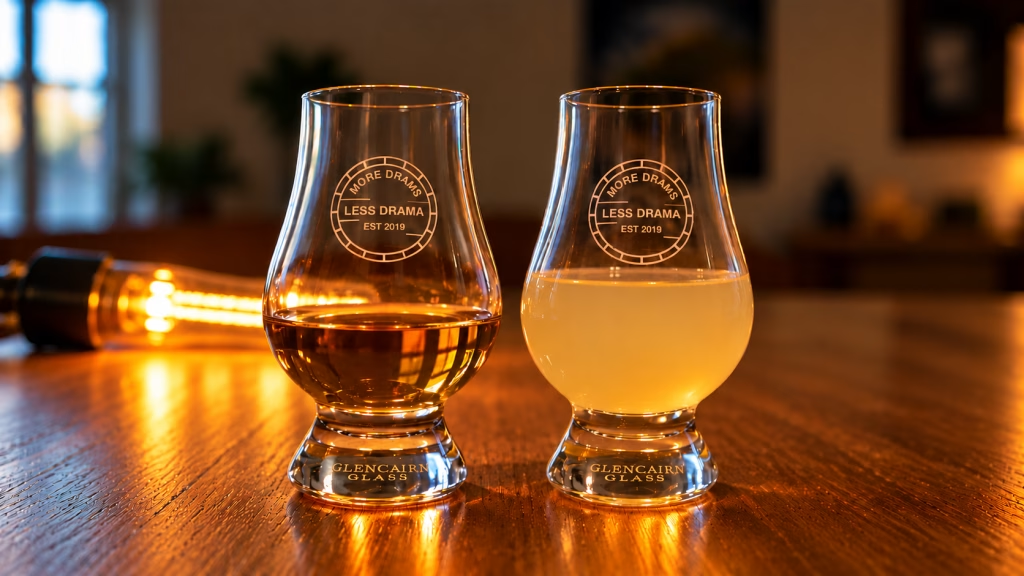
Whisky contains various fatty acids and fatty acid esters, some of which are poorly soluble in water-rich solutions. At higher ethanol concentrations, these substances may remain dissolved. But when the alcohol concentration falls, their solubility can decrease.
Some molecules can aggregate into tiny particles or colloidal structures that scatter light. The result is a cloudy or milky appearance.
Lower temperatures can make the effect more pronounced because they further reduce the solubility of certain compounds. This is why adding cold water or ice can produce haze in a whisky that was previously perfectly clear.
The famous 46% threshold
You’ll often hear that whisky becomes cloudy below 46% ABV. There’s a reason that number is frequently mentioned.
Many producers bottle non-chill-filtered whiskies at 46% ABV or higher because doing so reduces the likelihood of haze developing during normal storage and handling.
But 46% isn’t a universal chemical threshold.
The actual behaviour depends on the concentrations and types of fatty acids and esters present, the temperature, the alcohol strength and other components of the whisky. Some whiskies can develop haze above 46%, while others remain clear below it.
The number is a useful industry convention, not a law of nature.
Does cloudiness mean the whisky is better?
Not necessarily. Haze can indicate that certain compounds haven’t been removed through chill filtration, but cloudiness alone doesn’t establish superior flavour, greater complexity or better texture.
Nor does a perfectly clear whisky necessarily mean it has been heavily filtered. The composition of the spirit matters.
That said, the substances responsible for haze can also influence the behaviour of aroma compounds.
Research published in 2012 examined the effects of ethanol and long-chain ethyl esters on volatile compounds in a whisky model system. The researchers found that the presence of a long-chain ester could selectively reduce the headspace concentrations of more hydrophobic aroma compounds.
This is particularly interesting because it means that fatty acid esters may influence aroma release, not merely the whisky’s appearance. Their effects can also change as the whisky is diluted.
So haze formation and aroma behaviour aren’t entirely separate topics. They’re different consequences of the same complicated mixture.
Chill filtration: keeping whisky clear
Chill filtration is used to reduce the likelihood of haze developing in bottled whisky. The process generally involves cooling the whisky so that certain poorly soluble substances form particles or aggregates, then removing them through filtration.
The objective is primarily visual stability. A whisky that remains clear when chilled or diluted is less likely to worry consumers unfamiliar with natural haze formation.
But the process also removes some compounds that would otherwise remain in the spirit.
Does that affect flavour?
Potentially. The difficult question is how much.
Removing fatty acid esters and other substances can alter the composition of the whisky. Some of those compounds may contribute directly to flavour or influence the release of other aroma molecules.
However, the size and sensory significance of those changes depend on the whisky and the filtration conditions. We shouldn’t assume that every chill-filtered whisky has been stripped of flavour, nor that every non-chill-filtered whisky is richer, oilier or more complex.
The relevant comparison would involve the same whisky before and after filtration, ideally evaluated through controlled sensory testing.
Still, if a producer wants to preserve as much of the original spirit composition as practical, avoiding chill filtration is a defensible choice.
Just don’t confuse the presence of haze with a guarantee of quality.
How much water should you add?
Now that we’ve covered the chemistry, we arrive at the practical question: how much water should we actually add to a whisky?
Unfortunately, science doesn’t provide a universal answer. And it probably never will.
Different whiskies contain different mixtures of aroma compounds. They also have different bottling strengths, textures and flavour intensities. A heavily peated whisky at 60% ABV may respond very differently from a delicate, unpeated whisky at 46%.
Individual preferences matter too. Some people enjoy the intensity and texture of high-strength whisky. Others find the alcohol overwhelming and prefer a lower concentration.
Neither preference is chemically incorrect.
The useful approach is to understand what dilution does and experiment accordingly.
A practical example
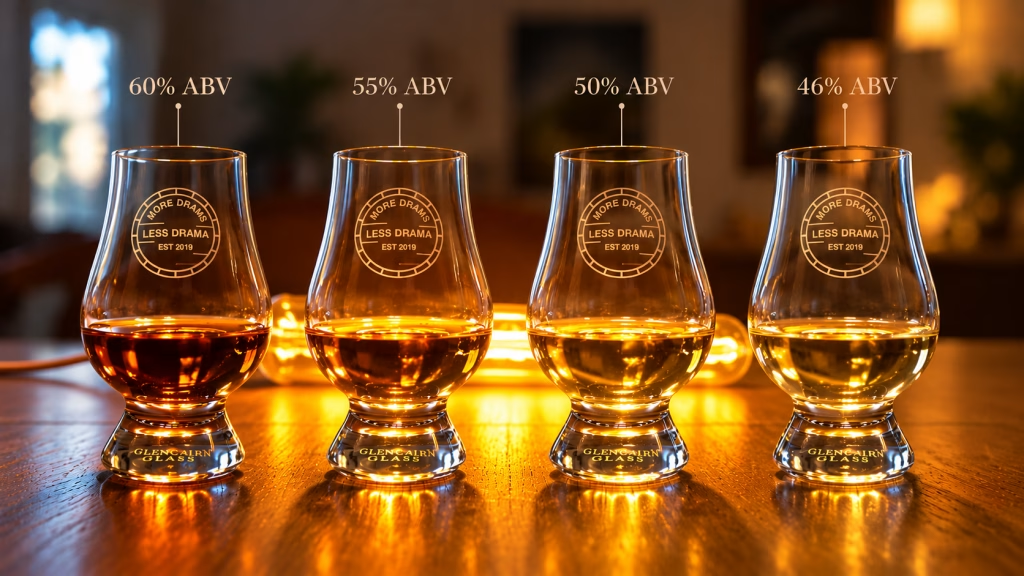
Imagine pouring 30 ml of whisky at 60% ABV. How much water would you need to reach different strengths?
| Target strength | Water to add |
|---|---|
| 55% ABV | Approximately 2.7 ml |
| 50% ABV | Approximately 6 ml |
| 46% ABV | Approximately 9.1 ml |
| 40% ABV | Approximately 15 ml |
These are approximate calculations that treat the volumes as additive. In reality, ethanol-water mixtures contract slightly when mixed, and precise dilution calculations require density data and temperature corrections.
Still, the table demonstrates something important. Reducing a 60% whisky to 55% doesn’t require much water, whereas reducing it to 40% requires a substantial amount. And the difference between those two results can be enormous.
This is also why the familiar advice to add just a few drops isn’t particularly precise. The effect depends on how much whisky is in the glass, its original strength and the volume of the drops.
A few drops in a 10 ml tasting sample aren’t equivalent to a few drops in a 50 ml pour.
Is there a best method?
If you’re comparing the effects of dilution, a sensible approach is to begin at bottling strength and assess the aroma and texture before adding anything. Then add a small, measured amount of water and reassess.
You may discover that a whisky becomes more expressive, less pungent or more balanced. Or you may discover that it loses some of the characteristics you enjoyed.
For a more controlled comparison, you can divide the same whisky into several identical glasses and dilute each to a different strength. This avoids the difficulty of trying to remember how the whisky smelled before successive additions of water.
The Domaine des Hautes Glaces Epistémè experiment offers a related comparison at the bottling stage, with the different strengths available as separate expressions.
The point isn’t to keep adding water until the whisky reaches a predetermined strength. It’s to identify how its character changes and, importantly, to recognise when additional dilution stops improving your experience.
What about the quality of the water?
Distilleries sometimes make a great deal of their water sources, and water quality certainly matters during whisky production.
But when we’re discussing a few millilitres added to a glass, the most important consideration is generally that the water is clean and doesn’t introduce noticeable unwanted flavours.
Strongly chlorinated water, for example, may affect the aroma. Water with substantial mineral content can also behave differently from demineralised water, although the practical sensory significance depends on the quantities involved.
For controlled experiments, researchers commonly use purified water to reduce variability. For ordinary whisky tasting, clean, neutral-tasting water is a reasonable choice.
You don’t need water collected from the same stream that supplied the distillery. And there’s no convincing reason to believe that a few drops of expensive bottled water will automatically reveal more flavour than an equally neutral alternative.
The whisky is complicated enough already.
Does whisky need time to open up after adding water?
Another familiar piece of advice is to add water, then wait. Sometimes people recommend a few minutes. Others suggest much longer.
There are plausible reasons why the experience may change after dilution. Mixing water and ethanol changes the liquid’s composition, and volatile compounds redistribute between the whisky and the headspace. The glass also continues exchanging volatile molecules with the surrounding air.
Meanwhile, temperature may change, and some compounds may slowly evaporate.
But that doesn’t establish a universal waiting time.
The initial mixing and molecular rearrangements don’t require whisky to rest for twenty minutes before they can occur. And changes noticed after a longer period may involve evaporation, temperature, adaptation of the nose or other effects.
So waiting can be worthwhile as part of a tasting experiment. Just don’t assume that every whisky needs a specific number of minutes to unlock its hidden secrets.
Too long, didn’t read
(Adding water won’t make this section any shorter.)
Adding water changes much more than whisky’s alcohol concentration. It alters the environment in which aroma compounds are dissolved and can change how readily different molecules enter the headspace. Some aromas may become more prominent, while others become less noticeable.
Research supports these compound-specific effects, but there’s no scientific basis for claiming that water always makes whisky better.
My comparison of three Domaine des Hautes Glaces whiskies from the same cask, bottled at 46%, 52% and 59% ABV, illustrated how different strengths can produce markedly different sensory impressions. The middle strength was actually my least favourite.
Dilution also reduces alcohol-related irritation, which can make delicate aromas easier to perceive without necessarily increasing their concentration. Water changes texture and mouthfeel, and it can cause fatty acids and esters to form haze, particularly at lower temperatures.
The familiar 46% ABV threshold is a useful convention, not an absolute chemical boundary. Chill filtration reduces haze formation but may also remove compounds that influence flavour and aroma behaviour.
And there’s no universally ideal drinking strength.
Water doesn’t simply reveal whisky’s flavour. It changes the balance of what we smell, taste and feel.
Conclusion: to dilute or not to dilute?
The advice to add a few drops of water to whisky isn’t nonsense. There are genuine chemical and sensory reasons why dilution can change our experience.
But the familiar explanation that water simply opens up the whisky is too simplistic.
Some aroma compounds become more prominent. Others become less noticeable. Ethanol’s irritating effects diminish, texture changes and certain compounds may even come out of solution.
Sometimes the result is wonderful. Sometimes it isn’t.
And that’s the paradox.
Adding water can make particular flavours easier to detect while simultaneously making the whisky less concentrated and potentially less distinctive.
The Domaine des Hautes Glaces comparison was a useful reminder of that complexity. At 46%, the whisky was balanced and approachable. At 52%, it became more austere. And at 59%, the fruit returned alongside greater texture and intensity.
Three different strengths. Three different impressions. No straightforward progression towards an ideal balance.
The objective therefore isn’t to find the strength at which the greatest possible number of aroma molecules escapes from the glass. It’s to find the balance between aroma, flavour, texture and alcohol intensity that makes the whisky most enjoyable.
So should you add water?
Try it, if you want to. Just remember that the whisky isn’t necessarily becoming more complex. You’re changing how its existing complexity is presented.
And sometimes, the best amount of water is none at all.
References and further reading
Scientific research
- Karlsson, B. C. G. & Friedman, R. (2017). “Dilution of whisky – the molecular perspective.” Scientific Reports, 7, 6489. Molecular dynamics simulations examining the behaviour of guaiacol in ethanol-water mixtures. Full open-access paper.
- Ashmore, P. L., DuBois, A., Tomasino, E., Harbertson, J. F. & Collins, T. S. (2023). “Impact of Dilution on Whisky Aroma: A Sensory and Volatile Composition Analysis.” Foods, 12(6), 1276. Chemical analysis of 25 whiskies at multiple dilution levels, together with sensory evaluation of a smaller selection. Full open-access paper.
- “Effects of Ethanol and Long-Chain Ethyl Ester Concentrations on Volatile Partitioning in a Whisky Model System” (2012). Journal of Agricultural and Food Chemistry, 60(40), 9959–9966. Investigation of how ethanol and long-chain ethyl esters affect the headspace concentrations of whisky aroma compounds. Abstract and publication details. Full-text open access not confirmed.
- “Influence of Ethanol on Flavor Perception in Distilled Spirits” (2019). In Sex, Smoke, and Spirits: The Role of Chemistry, ACS Symposium Series, pp. 277–290. Discussion of physicochemical and sensory mechanisms through which ethanol concentration influences flavour perception. Abstract and publication details. Full-text open access not confirmed.
Distillery and technical references
- Annandale Distillery. “Chill Filtration.” Technical discussion of fatty acids, esters, haze formation and filtration. Read the technical note.
- Bruichladdich Distillery. “Guide to Chill Filtration.” Explanation of haze-forming fatty acid esters, solubility and non-chill filtration. Read the article.
- Eaton Filtration. “As Clear as Amber.” Technical article on whisky haze formation, fatty acid esters and chill-filtration processes. Read the technical PDF.
Practical tasting comparison
- More Drams, Less Drama (2026). “Domaine des Hautes Glaces Epistémè R15D24.” Side-by-side tasting of three bottlings from the same ex-Vin Jaune cask at 46%, 52% and 59% ABV, examining changes in aroma, flavour and texture. Read the full review.