
Yeast, wild microorganisms, esters and the chemistry behind whisky’s fruity flavours.
Whisky is made from grain, water and yeast. Ask what yeast does, and the usual answer is straightforward: it converts sugar into alcohol. Technically correct, but rather incomplete.
Fermentation is also responsible for producing many of the compounds that give whisky its fruity, floral, cereal and sometimes rather unpleasant aromas. Long before the spirit encounters a copper still or an oak cask, much of its aromatic foundation is already taking shape.
And while distilleries love to talk about long fermentations, special yeast strains and tropical fruit notes, the relationship between fermentation and flavour is considerably more complicated than the marketing might suggest.
So what actually happens inside a washback? Does a longer fermentation really mean a fruitier whisky? And could the wild microorganisms living in a distillery be just as interesting as the yeast deliberately added to its wort?
Fermentation: more than sugar into alcohol
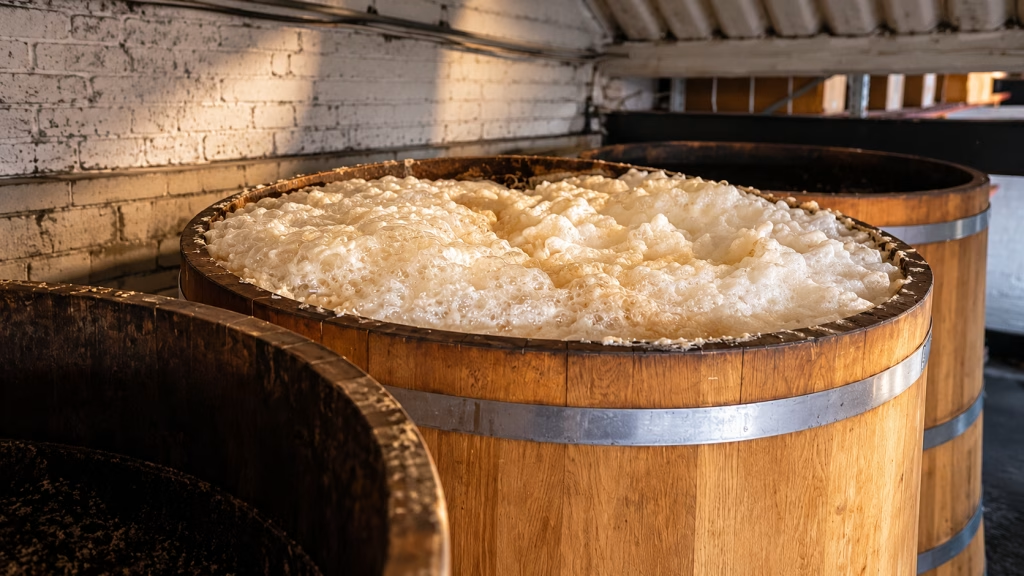
Once malted barley has been mashed, the distillery has a sugary liquid called wort. This is transferred to a washback, where yeast is added to begin fermentation.
The yeast used in Scotch whisky production is generally Saccharomyces Cerevisiae, the same species widely used in brewing and baking, although different strains can behave quite differently.
Its primary job is to consume fermentable sugars and produce ethanol and carbon dioxide:
Sugar → Ethanol + Carbon dioxide
Simple enough.
But yeast doesn’t live on sugar alone. It also uses amino acids, minerals and other nutrients to grow and maintain its metabolism. During these processes, it produces numerous additional substances, including higher alcohols, organic acids, aldehydes and esters.
These substances are often collectively called congeners: compounds other than ethanol and water that contribute to the character of a spirit.
Some are produced directly by yeast. Others arise through reactions between fermentation products or through the activity of bacteria.
This means fermentation isn’t merely preparing an alcoholic liquid for distillation. It’s creating much of the chemical material from which the whisky’s aroma will develop.
What exactly is yeast?
Yeast isn’t a bacterium, nor is it a plant. It’s a microscopic, single-celled fungus, belonging to the same biological kingdom as mushrooms and moulds. Unlike bacteria, yeast cells are eukaryotes: they have a nucleus containing their DNA and specialised internal structures.
Most whisky fermentation relies on Saccharomyces cerevisiae, a species that generally reproduces by budding, with a small new cell growing from a parent cell before separating. Like other living organisms, yeast needs energy and nutrients to survive and reproduce. It can obtain energy from sugars through respiration or fermentation, depending on the conditions.
During alcoholic fermentation, it converts sugars into ethanol and carbon dioxide, while also producing numerous other compounds that influence whisky’s aroma. So yeast isn’t simply an ingredient that magically turns sugar into alcohol.
It’s a living microorganism whose metabolism helps define the character of the spirit.
Where do those fruity aromas come from?
When we describe a whisky as smelling of bananas, pears, apples or pineapple, we’re often detecting compounds belonging to a chemical family called esters.
Esters can form through reactions involving alcohols and organic acids. Yeast also produces many esters through enzyme-controlled metabolic processes.
Different esters have different characteristic aromas.
| Compound | Typical aroma associations |
|---|---|
| Isoamyl acetate | Banana, pear drops |
| Ethyl hexanoate | Apple, fruity notes |
| Ethyl octanoate | Fruity, pineapple-like notes |
| Ethyl butanoate | Pineapple, tropical fruit |
| 2-Phenylethyl acetate | Floral, rose, honey-like notes |
| Ethyl acetate | Fruity at lower concentrations; solvent-like at higher ones |
These descriptions are only guides. A compound doesn’t smell exactly the same at every concentration or in every mixture.
And a whisky smelling of pineapple doesn’t necessarily contain one particular pineapple molecule. That impression may come from several compounds acting together.
There’s another important detail: esters need chemical building blocks, including alcohols and acids.
Yeast produces ethanol and various higher alcohols. Both yeast and bacteria can also contribute organic acids. These substances provide opportunities for ester formation during fermentation and subsequent stages of whisky production.
Acetic acid is an interesting example. It can contribute to the formation of acetate esters, some of which have attractive fruity aromas. But acetic acid itself is associated with vinegar, and excessive amounts can be undesirable.
So producing more acid isn’t automatically a good thing. The balance between acids, alcohols, esters and other compounds matters.
This helps explain why some distilleries produce naturally fruity spirits before any influence from oak.
That tropical fruit character in an old refill-bourbon whisky may have its roots in fermentation decades earlier.
Of course, distillation and maturation also matter. But the fruit doesn’t necessarily come from the wood.
Yeast: not all strains are equal.
If yeast influences flavour, choosing the strain should be important.
And it is.
Different yeast strains vary in their ability to ferment sugars, tolerate alcohol and temperature, and produce aroma compounds.
In 2021, Christopher Waymark and Annie Hill investigated 24 commercially available dried yeast strains and their influence on whisky new-make spirit.
Their study confirmed that yeast selection could affect aroma and ester concentrations. Distilling, brewing and wine yeasts showed differences in their chemical profiles.
But here’s an interesting complication: the researchers didn’t find statistically significant differences between individual strains in the intensity of seven broad whisky aroma categories.
In other words, measurable chemical differences don’t always translate into obvious sensory differences.
Interestingly, the spirits produced using brewing yeasts received higher overall acceptability ratings in that experiment.
That doesn’t prove brewing yeast is better for whisky. It demonstrates that yeast selection involves more than choosing the strain that produces the most alcohol.
Historically, many distilleries have used brewing yeast, sometimes alongside distillers’ yeast. Modern specialised distilling strains offer advantages in alcohol yield, reliability and consistency.
But those advantages don’t necessarily make them the most interesting choice for every flavour profile.
What about using several yeasts?
A distillery doesn’t necessarily have to rely on a single yeast strain.
Different yeasts can be combined in the same fermentation or introduced at different stages. This is known as sequential fermentation when one microorganism is introduced before another.
For example, a producer might initially use a yeast selected for its aroma-producing potential, then introduce a more efficient distilling yeast to complete the conversion of sugars into alcohol.
The idea is to combine flavour development with reliable fermentation.
And this isn’t limited to experimental distilleries. At Brittany’s Armorik, for example, the distillery describes using two yeast strains: one selected for alcohol production and another for aromatic properties.
However, different microorganisms can compete for nutrients, produce compounds that inhibit one another or behave unpredictably when combined.
Using several yeasts isn’t automatically better than using one.
It’s another variable that distillers can experiment with.
Wild yeast: whisky’s uninvited guests.
So far, we’ve mostly discussed yeast deliberately introduced by the distiller. But what about the yeasts that arrive without an invitation?
Wild yeasts are naturally occurring yeasts found on grain, in the environment and on production equipment. Unlike selected commercial strains, they haven’t necessarily been isolated and propagated specifically for whisky production.
And they aren’t all Saccharomyces cerevisiae.
Wild yeast populations can include species from genera such as Pichia, Hanseniaspora and Brettanomyces, among many others. Different species have different abilities to consume sugars and produce alcohol, acids and aroma compounds.
Some can produce interesting fruity or floral aromas. Others generate funky, spicy or medicinal notes, while certain species can create distinctly unpleasant flavours.
Some also struggle to ferment maltose, one of the principal sugars in whisky wort, making them unsuitable for completing alcoholic fermentation on their own.
This is where spontaneous fermentation becomes interesting.
Instead of relying exclusively on an added commercial yeast, the producer allows microorganisms naturally present in the raw materials or environment to initiate fermentation.
But spontaneous fermentation doesn’t mean that anything goes. Its microbial population changes over time, and the results can be difficult to predict or reproduce.
There’s also an important distinction between spontaneous fermentation and deliberately adding a cultivated wild yeast.
Once a yeast has been isolated, identified and propagated, its origin may be wild, but its use is controlled.
A particularly interesting example is Brettanomyces, a yeast associated with certain traditional beers and wines. It can produce distinctive fruity, leathery, spicy and farmyard-like aromas, depending on the strain and fermentation conditions.
Those characteristics might be desirable in one spirit and considered defects in another.
But wild yeast isn’t automatically better, more traditional or more flavourful than commercial yeast.
Its value lies in the possibility of introducing different metabolic pathways and aroma profiles, at the cost of greater complexity and potentially less predictable fermentation.
And there’s another possibility: a distillery can deliberately add conventional yeast, then allow naturally occurring microorganisms to contribute later.
Temperature matters too.
Yeast doesn’t behave identically at every temperature.
Fermentation temperature affects how quickly yeast works, how it uses nutrients and which aroma compounds it produces.
In traditional Scotch malt whisky production, fermentation temperature is often not actively controlled throughout the process. Instead, distillers manage the initial temperature of the wort and allow fermentation to generate its own heat.
Temperatures can rise considerably as the yeast becomes active.
Research examining yeast strains and fermentation temperatures has demonstrated that different conditions can favour the production of different aroma compounds.
But there isn’t one universal temperature that produces the fruitiest whisky.
The result depends on the yeast, the wort and the compounds being considered.
And hotter isn’t automatically better. Excessive temperatures can stress yeast, affect fermentation efficiency and alter the balance of aroma compounds.
As usual, the interesting part is the interaction between variables.
Does longer fermentation make fruitier whisky?
This is probably the most familiar claim about whisky fermentation.
Short fermentation produces a relatively cereal-driven spirit. Long fermentation produces more fruity esters.
There’s a scientific basis for that generalisation, but it needs qualification.
During the early stages of fermentation, yeast actively consumes sugars and produces alcohol, carbon dioxide and numerous flavour compounds.
As fermentation progresses, the concentration of fermentable sugars falls and yeast activity changes.
At the same time, other microorganisms may become increasingly important.
In many Scotch malt distilleries, fermentation lasts roughly two to three days, although some use considerably longer periods.
Longer fermentation can allow additional chemical and microbial activity, potentially changing the concentrations of organic acids and esters.
But here’s the crucial distinction: fermentation time and the time needed to consume the available sugars aren’t necessarily the same thing.
A wash may have completed most of its alcoholic fermentation, while chemical and microbial activity continues.
Conversely, a slower yeast strain might take considerably longer to consume the sugars without necessarily producing the same flavour profile as a faster fermentation followed by an extended resting period.
The distiller behind Spheric Spirits discusses this distinction in a Whiskybase tasting, describing fermentations lasting seven days or more and experiments in which long-fermented components are combined with shorter fermentations.
His approach is based on giving different microorganisms opportunities to contribute to flavour, rather than focusing exclusively on rapid alcohol production.
It’s an interesting practical illustration, although these experimental results shouldn’t be treated as proof that longer fermentation always produces better whisky.
The important question isn’t simply how long does fermentation last?
It’s which microorganisms are active, what they’re producing and how those compounds develop over time.
Extending fermentation from 48 to 72 hours may produce a different result from extending it from 72 to 120 hours.
And even if additional esters are produced, they won’t necessarily all survive distillation or remain prominent after maturation.
So fermentation duration is useful information about a distillery, but it isn’t a reliable tasting note in disguise.
Bacteria: the unexpected contributors
Here’s something that surprises many whisky drinkers: traditional Scotch malt whisky fermentation isn’t sterile.
Unlike brewing, whisky production generally doesn’t include boiling the wort before fermentation.
Consequently, bacteria can enter the process through the raw materials, equipment and distillery environment.
Some of these bacteria belong to groups commonly called lactic acid bacteria, including species historically classified within Lactobacillus.
They’re often associated with spoilage in other contexts, but their role in whisky fermentation can be more interesting.
As fermentation progresses and yeast activity declines, certain bacteria may become more active. They can produce compounds such as lactic and acetic acids, depending on the species and conditions.
These acids can contribute to the formation of esters, including ethyl lactate and ethyl acetate.
That can influence the aroma of the spirit.
A study published in 2002 examined the bacterial communities present during malt whisky fermentation. The researchers found that their composition changed over time, with different bacterial groups becoming prominent at different stages.
This helps explain why extending fermentation can change flavour even when relatively little additional alcohol is being produced.
But bacteria aren’t automatically beneficial.
Uncontrolled bacterial growth can reduce alcohol yield, generate unwanted aromas and create production problems.
Acetic acid bacteria, for example, can oxidise ethanol into acetic acid when sufficient oxygen is available. Some acetic acids may provide useful flavour precursors, but too much can produce an unpleasantly acidic wash and reduce the alcohol available for distillation.
The objective is, therefore, not to encourage as much bacterial activity as possible.
It’s to understand which microorganisms are present and what they’re doing.
Sometimes, the microorganisms that weren’t deliberately invited to the party contribute to the flavour.
But they can also ruin it.
A second fermentation: when wild microorganisms take over.
One particularly interesting approach is to begin fermentation with a selected yeast and then leave the wash for several additional days.
The first stage is dominated by the deliberately added yeast, which converts most of the fermentable sugars into alcohol.
Later, as its activity declines, naturally occurring yeasts and bacteria may become more influential.
This is sometimes described as a secondary fermentation or late lactic fermentation.
However, the terminology needs care. It doesn’t necessarily mean that a second population of wild yeast starts producing large amounts of additional alcohol.
In many cases, the most important activity comes from bacteria producing organic acids and contributing indirectly to ester formation.
Wild yeasts may also participate, depending on which species are present and what nutrients remain available.
Several distilleries deliberately use long fermentations and open-topped wooden washbacks to encourage this kind of flavour development.
Bimber: long fermentation in open wooden washbacks
London’s Bimber Distillery uses open-topped washbacks constructed from American white oak.
The distillery describes fermentations lasting nearly a week, using its own selected yeast strains and carefully managed temperatures.
Bimber attributes part of its fruity spirit character to its fermentation regime and open washbacks.
The open design can expose the wash to the surrounding distillery’s environment, while the wooden surfaces may provide habitats for resident microorganisms.
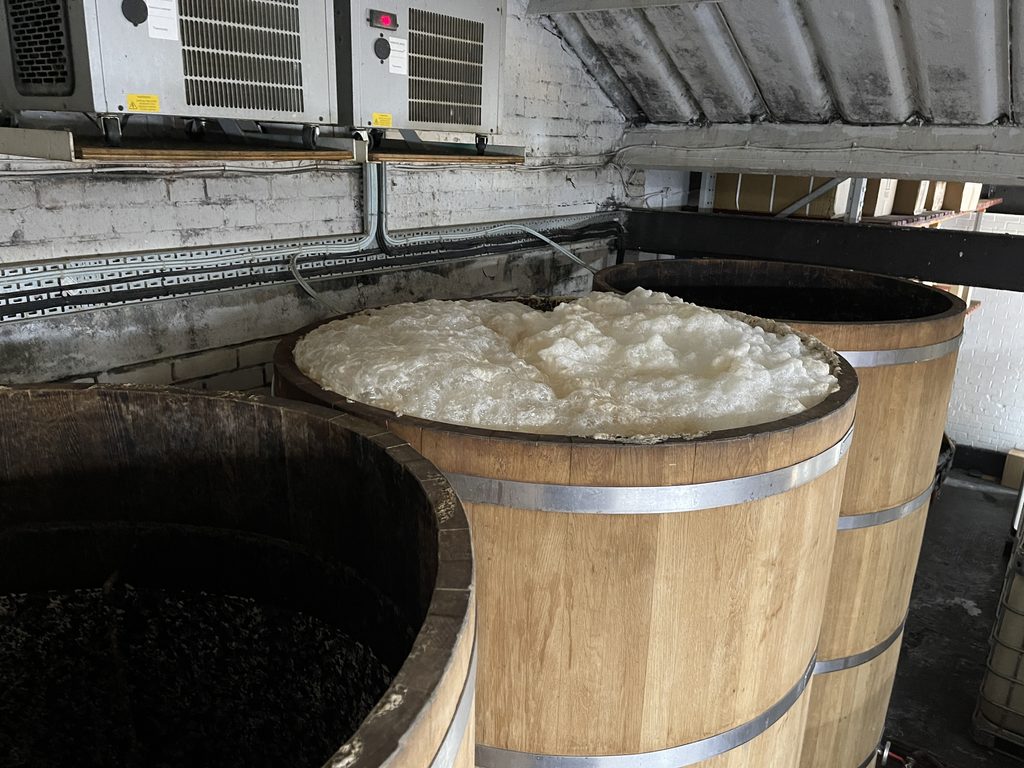
However, an open washback doesn’t automatically mean spontaneous fermentation, nor does it establish that wild yeast is responsible for a distinct second stage.
Bimber’s published explanation emphasises long fermentation, yeast performance and ester development rather than identifying a particular wild yeast population.
It’s a useful example of how a distillery can combine deliberate yeast inoculation with a fermentation environment that isn’t sealed off from naturally occurring microorganisms.
Dunphail: seven days and resident bacteria
At Dunphail Distillery in Scotland, the approach is more explicitly described.
Dunphail uses twelve open-topped wooden washbacks made from Douglas fir, with fermentation lasting approximately 168 hours, or seven days.
The distillery inoculates its wort with a selected yeast strain.
According to its production description, most alcohol is produced during the first three days. The remaining four days allow further flavour development, including activity involving bacteria naturally resident in the wood.
Dunphail specifically describes encouraging late bacterial fermentation to increase the formation of fruity aroma compounds.
This is an excellent illustration of the distinction between the initial alcoholic fermentation and subsequent microbial activity.
But notice that the distillery primarily credits bacteria, rather than claiming that a second wave of wild yeast is solely responsible for its fruity character.
Dornoch: wild yeast, bacteria and experimental fermentation
Dornoch Distillery, operated by the Thompson brothers, takes an especially interesting approach.
It uses open-topped wooden washbacks and has reported average fermentations of approximately 168 hours, with some considerably longer experimental batches.
In a 2022 production update, the distillery explained that its conventional yeast fermentation typically completed most sugar conversion after roughly 48 hours.
During the following days, naturally occurring yeasts and bacterial populations could become increasingly active.
Dornoch also described an experimental fermentation lasting almost four weeks, without adding commercial yeast at all.
That experiment was intended to encourage the distillery’s resident microorganisms, including potentially Brettanomyces.
The distinction is important: Dornoch has explored both conventional yeast fermentation followed by extended microbial activity and genuinely spontaneous fermentation without an initial commercial yeast addition.
The distillery has also experimented with blending separately fermented washes to influence acidity and flavour development.
These examples show that wild microorganisms aren’t necessarily something a whisky distiller must eliminate.
They can also be part of a deliberate production strategy.
Does leaving a washback open really make a difference?
An open washback may permit airborne microorganisms to enter the wash, but this doesn’t mean that the air is necessarily the main source of microbial activity.
Microorganisms can also originate from the malt, the wort, the equipment and existing populations within the washback.
And once fermentation is underway, the rapidly growing selected yeast may dominate the environment, limiting the opportunities available to newcomers.
The influence of wild microorganisms therefore depends on fermentation duration, temperature, acidity, oxygen availability, nutrient availability and the populations already present.
Nor does a closed stainless-steel washback guarantee the absence of bacteria or wild yeasts.
Open-topped washbacks can facilitate microbial interactions, but the open top alone doesn’t explain the resulting flavour.
The entire fermentation environment matters.
Wooden versus stainless-steel washbacks
This brings us to another popular distillery-tour discussion.
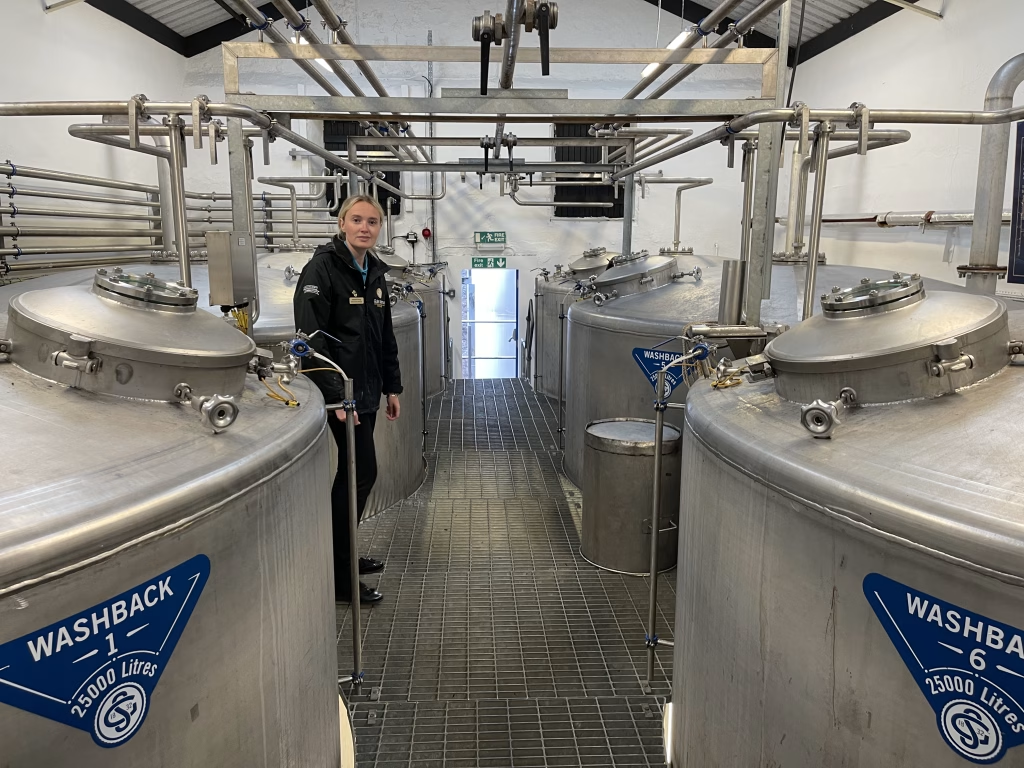
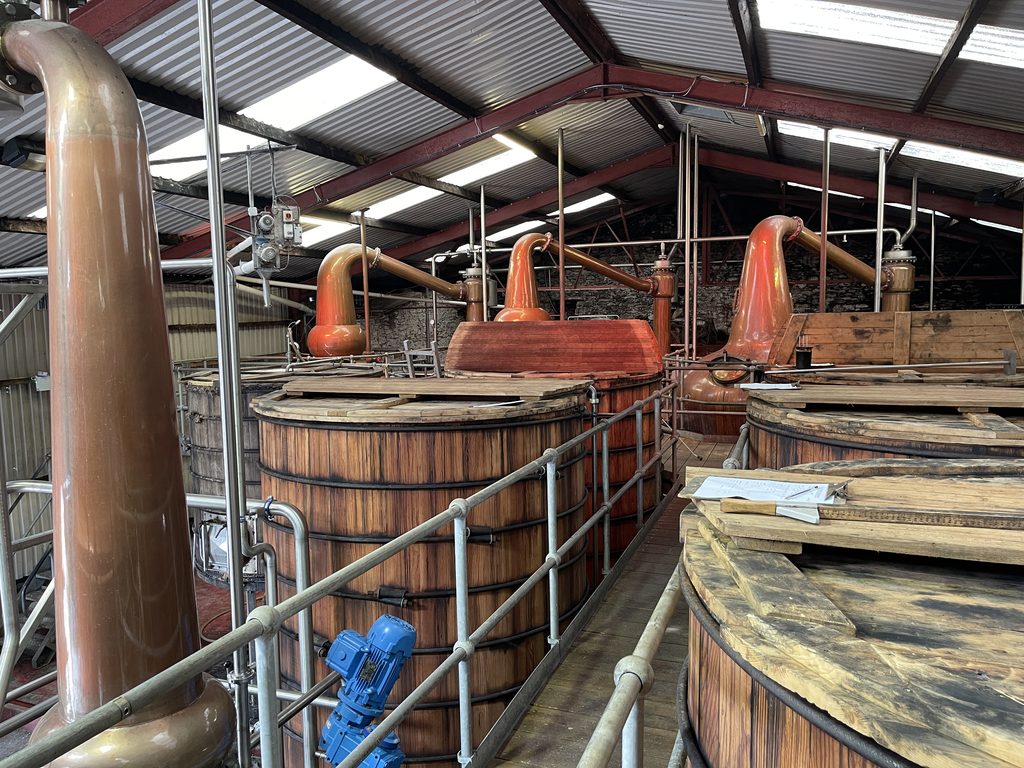
Some distilleries use traditional wooden washbacks, often made from Oregon pine or larch. Others use stainless steel.
Wooden washbacks are sometimes credited with encouraging bacterial activity and producing more complex or fruity spirits.
There’s a plausible reason for this: wood has a different surface structure from stainless steel and can provide environments in which microbial communities persist.
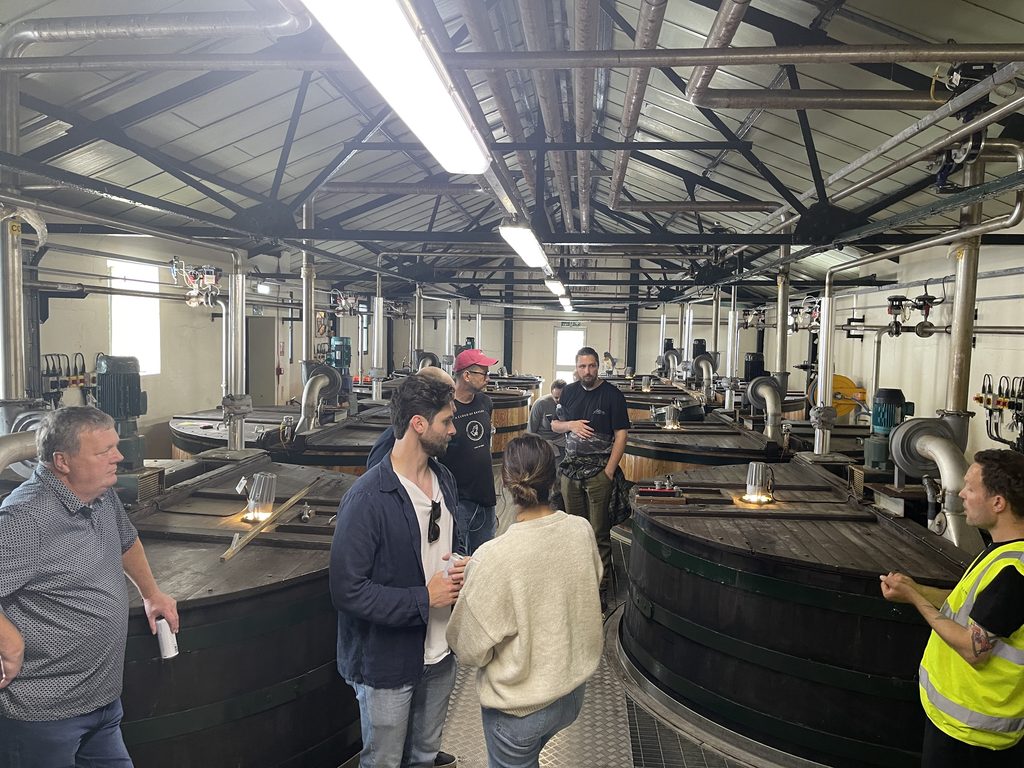
The Spheric Spirits discussion raises an interesting additional point.
The speaker argues that the potential influence of resident microorganisms may depend on fermentation duration. If an efficient yeast completes fermentation quickly, some slower-growing microorganisms might have relatively little opportunity to contribute.
A longer fermentation could provide more time for their activity to become significant.
That is consistent with research showing that bacterial populations change during fermentation.
But it would be a mistake to conclude that wooden washbacks automatically produce fruitier whisky, or that their influence becomes significant after a particular number of hours.
Stainless-steel washbacks aren’t necessarily sterile, and bacterial activity can occur in both systems.
Cleaning practices, temperature, fermentation duration and the microorganisms already present all matter.
Nor should we confuse wooden washbacks with oak maturation. The wood used in fermentation vessels isn’t intended to contribute the same extraction of tannins, vanillin and other oak compounds associated with years in a cask.
A wooden washback isn’t a giant whisky barrel.
Its potential influence is primarily connected to fermentation conditions and microbiology, not conventional oak ageing.
Beyond conventional yeast: an experimental example
Most whisky fermentation relies on Saccharomyces cerevisiae. But it isn’t the only yeast capable of producing interesting aroma compounds.
In the Whiskybase discussion, Spheric Spirits describes several collaborations using unconventional microorganisms.
One experiment at Nc’nean involved introducing a non-conventional yeast before conventional distillers’ yeast completed fermentation. The aim was to encourage the development of distinctive fruity aromas while still achieving a practical fermentation time.
Another experiment at Norway’s Aurora Spirit distillery involved a much more unusual approach: a fermentation lasting approximately one year, using a mixture that included Brettanomyces and traditional Norwegian kveik cultures.
Kveik refers to traditional Norwegian farmhouse brewing yeast cultures, some of which are known for unusual fermentation characteristics and flavour profiles.
According to the distiller, the resulting experimental spirit combined substantial fruitiness with funky characteristics and pronounced peat.
These are fascinating examples of what’s possible when fermentation becomes a deliberate tool for flavour exploration.
But they’re also individual experiments, described by the producer rather than independent controlled comparisons.
We shouldn’t assume that their results can be reproduced simply by adding Brettanomyces, using kveik or fermenting for a year.
The lesson is more general: different microorganisms can produce different flavour compounds, and fermentation offers more possibilities than simply choosing between two commercial distillers’ yeasts.
Whether those possibilities produce better whisky is another question entirely.
What survives distillation?
Fermentation produces many compounds, but not everything in the wash ends up in the new-make spirit.
Distillation separates compounds according to their behaviour in mixtures of ethanol and water. Some pass readily into the vapour, while others remain largely in the still.
The distiller’s choice of cut points also influences which compounds are collected.
And, as we discussed in the copper article, the equipment itself can participate in chemical reactions that change the composition of the spirit.
This means the aroma profile of the wash isn’t identical to that of the new make.
Some fermentation-derived esters survive distillation and contribute directly to spirit character. Others may be concentrated, reduced or transformed.
A fruity wash doesn’t guarantee an equally fruity spirit.
Fermentation provides the ingredients, but distillation decides which ones make it through – and in what proportions.
What happens during maturation?
Even after distillation, the story isn’t finished.
During maturation, whisky undergoes extraction from oak, oxidation, evaporation and numerous chemical reactions.
Some fermentation-derived compounds persist for decades. Others change in concentration or react to form new substances.
Esters can be formed, broken down or transformed during ageing, depending on the conditions.
Oak also introduces its own aroma compounds, including vanillin, oak lactones and various wood-derived phenols.
So when we encounter tropical fruit notes in an old whisky, we shouldn’t automatically credit fermentation alone.
The original distillate, the distillation process and the cask all contribute.
But fermentation remains fundamental because it establishes much of the spirit’s initial chemical character.
This is particularly apparent in refill casks, where less active oak can allow the underlying distillate to remain more recognisable.
A beautifully fruity refill-bourbon whisky isn’t necessarily the result of an unusually active cask.
Sometimes, the fruit was there from the beginning.
Can we predict whisky flavour from fermentation?
To a degree, but not nearly as precisely as some marketing claims suggest.
Knowing the yeast strain, fermentation duration and washback material can help us understand how a distillery operates.
But these details don’t tell us the concentrations of individual aroma compounds, how they interact or what survives distillation and maturation.
A 100-hour fermentation doesn’t guarantee tropical fruit. A wooden washback doesn’t guarantee complexity. And an unusual yeast strain doesn’t guarantee a distinctive finished whisky.
Even laboratory analysis has limitations: identifying an aroma compound doesn’t necessarily establish how important it is to the overall sensory experience.
Concentration, detection threshold and interactions with other compounds all influence what we actually smell.
The most convincing evidence comes from controlled experiments that combine chemical measurements with sensory evaluation.
That’s more useful than assuming that a production choice must create a particular tasting note.
Too long, didn’t read
(The yeast has finished working. You can too.)
Fermentation does much more than convert sugar into alcohol. Yeast also produces higher alcohols, acids and esters that contribute fruity, floral and other aromas to whisky.
Different yeast strains and fermentation temperatures can change the chemical profile of the wash and new-make spirit.
Wild yeasts can also contribute flavour, but wild, spontaneous and mixed-culture fermentation aren’t interchangeable terms.
Longer fermentation can encourage additional flavour development, partly through bacterial and wild-yeast activity, but longer doesn’t automatically mean fruitier.
Some distilleries, including Bimber, Dunphail and Dornoch, use open-topped wooden washbacks and extended fermentations. At Dunphail and Dornoch, later microbial activity is an explicitly described part of their production approach.
Wooden washbacks may influence the microbial environment, but they don’t automatically produce better or more complex whisky.
Finally, distillation and maturation substantially modify the compounds created during fermentation.
Fermentation creates much of whisky’s aromatic foundation. It doesn’t determine the finished flavour on its own.
Conclusion: whisky’s first flavour factory
Whisky enthusiasts often spend a great deal of time discussing still shapes, cask types and maturation.
And understandably so. Those factors have enormous effects on the finished spirit.
But fermentation deserves at least as much attention.
It’s where yeast transforms a sugary liquid into something far more chemically interesting, producing compounds that can contribute fruit, flowers, cereal notes and other characteristics long before the whisky encounters oak.
And yeast doesn’t always work alone.
Wild yeasts and bacteria may also contribute, particularly during longer fermentations or when distilleries deliberately encourage the development of resident microbial communities.
Yet there’s no universal recipe for the fruitiest or most complex spirit.
Longer fermentation isn’t automatically better. More esters don’t necessarily mean better whisky. And unusual yeast strains don’t guarantee extraordinary flavours.
As with copper, the objective isn’t to maximise one variable.
It’s to achieve the balance that gives a distillery its identity.
So the next time someone tells you that a whisky tastes of tropical fruit because it spent twenty years in a bourbon cask, remember that the story may have started much earlier.
Possibly in a washback, with a microscopic organism doing considerably more than making alcohol.
Or several microorganisms, some of which weren’t even invited.
References and further reading
Scientific research
- Waymark, C. & Hill, A. E. (2021). ‘The Influence of Yeast Strain on Whisky New Make Spirit Aroma.’ Fermentation, 7(4), 311. Experimental comparison of 24 yeast strains and their effects on new-make spirit. Full open-access paper.
- ‘The Potential for Scotch Malt Whisky Flavour Diversification by Yeast’ (2024). FEMS Yeast Research. A review of conventional and alternative yeasts, flavour formation and historical yeast use in Scotch whisky. Full open-access review.
- ‘Saccharomyces cerevisiae in the Production of Whisk(e)y’ (2016). Beverages, 2(4), 38. Overview of whisky yeast, fermentation conditions and flavour development. Full open-access article.
- ‘Evolution of the Lactic Acid Bacterial Community during Malt Whisky Fermentation: A Polyphasic Study’ (2002). Applied and Environmental Microbiology. Research into the changing bacterial populations during malt whisky fermentation. Full open-access paper.
- Heriot-Watt University – Research on pre-fermentation of malt whisky wort using Lactobacillus plantarum. Experimental investigation of bacterial treatment and its effects on new-make spirit composition. Freely available research manuscript (PDF).
Distillery production references
- Bimber Distillery (2019). ‘Work It Harder, Make It Better.’ Description of its open-topped wooden washbacks, selected yeast and extended fermentation. Read the article.
- Dunphail Distillery (2023). ‘Creation of Character.’ Detailed description of its seven-day fermentation, open-topped Douglas-fir washbacks and resident bacterial activity. Read the article.
- Dornoch Distillery (2022). ‘2022 Updates.’ Discussion of long fermentations, wild yeasts, bacteria and experimental spontaneous fermentation. Read the article.
- Dornoch Distillery (2023). ‘Christmas Fermentations Blog Post.’ Further experiments with spontaneous fermentation, acidity and mixed washes. Read the article.
Interviews and practical examples
- Spheric Spirits/Whiskybase – Online tasting and fermentation discussion. Experimental whisky production using mixed microbial cultures, sequential fermentation, Brettanomyces, kveik and extended fermentation. Particularly relevant sections: 25:27 – 35:18, 37:37 – 52:47 and 55:46–1:02:14. Watch the discussion.
- Whisky Magazine (2024). ‘Dornoch Distillery Looks to the Future.’ Interview and discussion of long fermentation, brewing yeasts and the role of native microbial populations in wooden washbacks. Read the article.